Twelve-speed SRAM Transmissions launched a few years ago and have become commonplace on high-performance cross-country, trail, and enduro bikes built around the SRAM UDH. We’ve seen the Transmission lineup evolve into a wide product range, and now Downhill is getting the Transmission treatment. XX DH Transmission is touting all of the same benefits as the pedal friendly Transmissions in a descending, focused, completely wireless, seven-speed package. DH racing is increasingly becoming a game of milliseconds, and the XX DH Transmission promises to shave off several throughout your race run; as long as your DH frame uses a UDH, of course.
 |
XX DH Specs
|
XX DH Transmission is taking SRAM's DH limelight from the X01 DH groupset. Launched in 2014, X01 has been largely unchanged since then, only receiving a small update in 2019. Trickle-down bikenomics has finally brought T-Type technology to downhill drivetrains with the XX DH Transmission, and there’s a new highest performance SRAM DH groupset. Considering this is an XX level groupset, the price reflects that. While SRAM doesn’t sell a complete XX DH kit like their other Transmissions, all of the components together will cost you around $2,150. I expect only the most dedicated DH racers to make that level of investment in their DH drivetrain, or those splurging on a truly special dream build.
SRAM's narrative surrounding the XX DH Transmission highlights three things: better shifting under load, easy setup, and a more robust derailleur. All three of these benefits mirror those in standard twelve speed Transmission systems, and it's not hard to imagine why they'd be beneficial in a downhill race scenario. Whenever you're pedaling, you're pedaling as hard as you can, and little to no mechanical sympathy is passed from the quads to the drivetrain when the clock is ticking. Easing off the power during a shift objectively loses riders time compared to mashing through the shift, so DH racers will mercilessly upshift two gears while barreling out of the start gate as fast as they can. Money shifting like this has ruined countless weekends, with a broken chain dashing your hopes of glory.

Excuse the tape over the logos, all the photos we have access to are censored
So, how does the XX DH Transmission let you stay on the power while shifting? The main party trick SRAM points to is Cassette Mapping, which keeps the chain fully engaged across multiple gears during a shift. SRAM has always employed shift ramps in its cassettes, and they’ve refined their design in this XX DH cassette to ensure that the chain is always fully supported. There’s not a moment where the chain is disconnected from the cassette during a shift, rather than only settling into a gear once it’s fully disengaged from the previous gear. Many people believe that T-Type AXS derailleurs wait to shift until the cassette and chain are in the correct orientation to make the perfect shift, but that’s not the case. The derailleur executes a shift instantly when called upon, leaving the cassette to massage the chain to the next gear when the time is right.
XX DH employs the XX chain, which, after years of testing under thousands of riders, has proven to be fantastically reliable, strong, and long-lasting. I imagine that third point will be especially true on a downhill bike that sees a fraction of the pedaling a trail bike does, and the narrower cassette means a better chainline for less wear. You could use nearly any T-Type chain with the XX DH Transmission, but SRAM says the XX SL chain is not approved- just like it’s not approved for ebike use. But if you want to use an Eagle 70, GX, X0, or XX chain, you won’t have any compatibility issues!
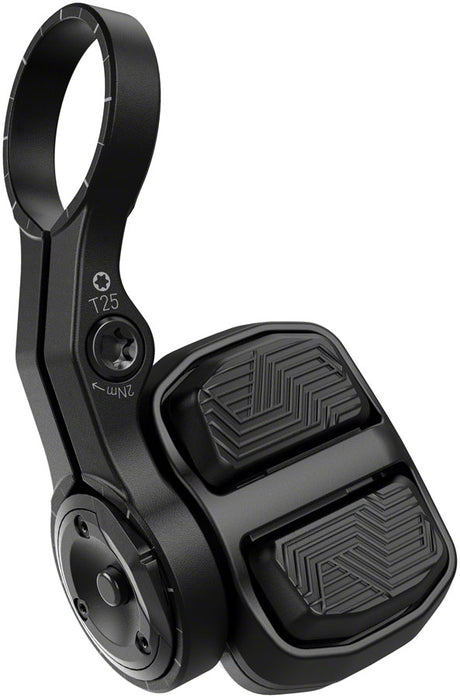
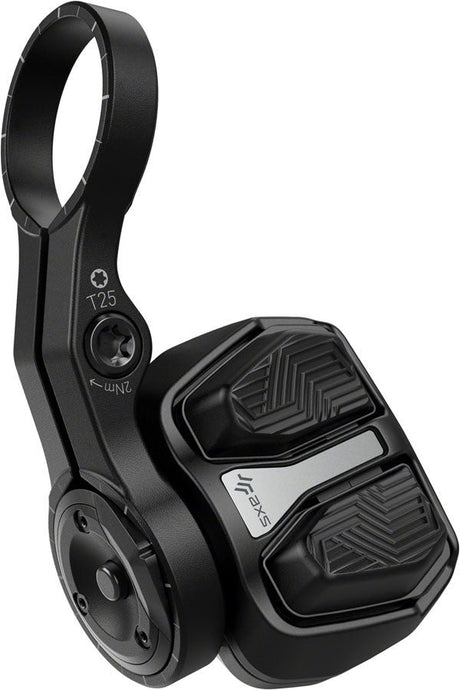
Another previously seen T-Type component that’s used in XX DH is the AXS Pod Controller, steering the whole ship. SRAM recommends that you use the Ultimate level Pod controller as it matches the XX level of this drivetrain, but you can use any AXS controller without issue as well. Whether that’s the original AXS Remote or a Pod Controller, pairing to the derailleur is the same procedure, so pick the AXS controller with the ergonomics you prefer.
 |
XX DH Derailleur Specs
|
Now for the new components. Let’s start with the XX DH Derailleur, which is the director of the whole XX DH System. As expected, it is a Full-Mount derailleur, more commonly referred to as a direct-mount derailleur. This will take the place of a Universal Derailleur Hanger by pinching the frame on both sides for increased strength and guaranteed alignment. It uses the shortest cage of any T-Type derailleur we’ve seen, and it’s as rebuildable as other T-Type derailleurs. Those skid plates, outer parallelogram links, and the whole cage are easily replaceable to keep this expensive derailleur ticking. SRAM claims this is the strongest derailleur they’ve ever made, and it also sits slightly further inboard than a typical derailleur, so it’s less susceptible to taking hits in the first place. Like other T-Type derailleurs, the electric motor holding it in place will allow the derailleur to move inboard when it inevitably does hit something out on the trail, which mitigates damage, and your derailleur will pop right back into place once the coast is clear.
| The XX DH Derailleur uses the same AXS battery as other AXS derailleurs and uses the same Type 4 damper found in other T-Type derailleurs. Because the cage is so short, you can expect far less chain slap than a twelve-speed T-Type derailleur, and an incredibly quiet ride. Well, that’s aside from the audible zrbbrp accompanying every shift. The outgoing X01 DH Derailleur used the Type 3 clutch, which is less strong than the Type 4. In my experience, the X01 derailleur has been best in class for mitigating chain slap, so I’m expecting even more from the XX DH derailleur. While it is an XX level derailleur, it does not have the Magic Pulley Wheels found in the twelve speed XX Derailleur, and instead has proprietary XX DH pulleys. The XX DH pulleys are both 14t, rather than one 14t and one 16t, and are overall tougher pulley wheels designed specifically for downhill racing. |
 |
 |
XX DH Crankset Specs
|
Aside from the XX label, the XX DH crankset looks just like the X0 T-Type crankset at first look, with the same “machined for wear” aluminum construction and signature window through the middle, but further inspection reveals it’s not a carbon copy. The XX DH cranks are more robust than the X0 cranks, with more material used throughout, and a noticeably smaller window than the X0 cranks. Downhill riders typically want shorter cranks than trail riders, so the XX DH cranks come in 150, 155, 160, and 165mm lengths to meet those wants.
XX DH cranks are offered with either a DUB DH spindle or a DUB Wide spindle to be compatible with just about every bike out there. Regardless of whether your frame uses DH hub spacing and a 56.5mm chainline or trail bike hub spacing and a 55mm chainline, both can run XX DH cranks. So if you’re looking for the strongest cranks you can get for your trail bike, the XX DH crankset is exactly that. The DUB DH spindle-equipped cranks come with a brand new XX DH T-Type chainring that’s the strongest T-Type chainring available, and uses the standard 8-bolt T-Type mounting interface. The DUB Wide spindle-equipped cranks come with the trail-oriented XX chainring.
 |
XX DH Cassette Specs
|
Last but certainly not least, there is, of course, a new XX DH cassette to tie everything together. And there’s not one, but actually two cassettes. More on that later. The XX DH cassette is the first seven-speed T-Type cassette, and has a full X-SYNC profile to facilitate improved shifting under load. X-SYNC is SRAM speak for narrow wide, which was reserved for 1x chainrings until they found that it helped tremendously with chain retention in cassettes as well! You’ll notice the red ring that indicates the setup cog, and the cassette has a typical 10-24t range. Because it’s a T-Type cassette, you’ll need to use a T-Type chain with the XX DH cassette for everything to work properly. Of course, the XX DH cassette uses an XD Driver, but SRAM is also introducing a new freehub standard, XD SLIM. That means there is a standard XD XX DH cassette, and an XD SLIM XX DH cassette, and you’ll need to get the cassette that corresponds to your freehub.
XD SLIM is the same idea as the rarely mentioned HG Slim/Mini HG freehub. Narrow-range DH cassettes don’t need as wide a freehub, so the hub shell can be wider to build a stronger wheel. Another freehub standard getting added to the books isn’t something that thrills me, but XD SLIM isn’t hurting anyone. You can mount your XD XX DH cassette to your current XD freehub-equipped hubs without worrying about XD SLIM. You won’t be able to convert your current hubs to XD SLIM, as it’s built around a different hub shell than a standard hub, so you’ll need to buy a whole new hub or wheelset to take advantage of the XD SLIM. While no XD SLIM hubs have been released as I write this article, SRAM has indicated that several hub manufacturers will release hubs with XD SLIM compatibility in the near future.

Final Thoughts
Writing this article made me realize that neither of the major drivetrain players have redesigned their DH lineup in over a decade, making the XX DH drivetrain a meaningful improvement in performance compared to the other options on the market. Unfortunately, the price is immense, and spending over two thousand dollars on the drivetrain of a downhill bike is not an easily stomached expense. Not only that, but most downhill bikes don't have a UDH, making them incompatible from the start. But I imagine that will change as new bikes are released, and die-hard downhill racers looking for every marginal gain possible will surely be looking to squeeze this into their budget. SRAM has made the least influential component on a downhill bike a performance advantage, and I’ve got my fingers crossed for a more affordable, cable-actuated T-Type DH drivetrain in the future.